How to Plan Living Walls on a Budget: A Professional Design Guide
The architectural allure of vertical greenery often arrives with a prohibitive price tag, creating a perception that living walls are exclusive to high-budget corporate lobbies or luxury estates. However, the true cost of a living wall is rarely found in the foliage itself, but in the proprietary hardware, automated fertigation systems, and specialized labor typically associated with commercial installations. How to Plan Living Walls on a Budget. To circumvent these costs without inviting systemic failure, one must deconstruct the vertical garden into its core functional components: structural support, moisture management, and biological sustenance.
Achieving a high-performance vertical garden under financial constraints is less about finding “cheap” materials and more about the strategic application of “low-tech, high-intelligence” engineering. It requires a shift from purchasing a pre-packaged solution to designing a bespoke system that leverages existing environmental assets. By understanding the physics of vertical water movement and the specific metabolic needs of epiphytic and lithophytic plants, it becomes possible to build systems that are both fiscally responsible and biologically resilient.
This analysis serves as a clinical guide for those seeking to bridge the gap between ambitious biophilic design and practical fiscal limits. We will explore how to prioritize capital expenditure (CAPEX) on critical failure-prevention items—such as waterproofing and drainage—while utilizing cost-effective alternatives for secondary features. The objective is to produce a vertical garden that functions with the reliability of a high-end installation at a fraction of the traditional market rate, focusing on long-term stewardship over immediate aesthetic impact.
Understanding how to plan living walls on a budget
The challenge of how to plan living walls on a budget is frequently undermined by the “aesthetic trap.” Beginners often prioritize the visual density of the plants during the initial purchase, leading to overspending on nursery stock that the underlying infrastructure cannot yet support. To plan effectively, one must treat the project as an infrastructure problem first and a gardening project second. A budget-friendly living wall is a masterpiece of containment and delivery; if the waterproofing or irrigation fails, the “savings” on the plants become a total loss as the structural damage to the building facade accrues.
One of the most significant misunderstandings in budget planning is the reliance on “DIY hacks” found in viral media. While repurposed wooden pallets or plastic bottles appear inexpensive, they often lack the durability required for the permanent moisture cycles of a living wall. These materials degrade rapidly, leading to mechanical failure and the need for a total system replacement within 18 months. A professional-grade budget plan focuses on “modular simplicity”—using standardized, industrial-grade materials like UV-rated polymers or EPDM liners that offer long-term performance without the premium branding of “living wall” proprietary kits.
Oversimplification also risks ignoring the “energy cost” of the wall. A budget system that requires manual daily watering will eventually fail due to human error or labor fatigue. Therefore, the budget must be allocated toward “passive automation.” This involves utilizing gravity-fed systems or simple, heavy-duty battery-operated timers that reduce the daily operational burden. The goal is to create a system where the complexity is hidden in the design phase, allowing for a low-cost, low-effort maintenance phase.
The Systemic Evolution of Vertical Horticulture Economics
The economic history of living walls has transitioned from naturalistic vines to high-tech hydroponics, and now, toward a “democratized” middle ground. Historically, vertical greenery was “budget-friendly” by default: climbing plants like Parthenocissus (Boston Ivy) required only a hole in the ground and a trellis. However, the damage these plants caused to masonry and the lack of control over their growth led to the development of the “Mur Végétal” by Patrick Blanc. These early engineered systems were prohibitively expensive due to the specialized felts and custom pump arrays required to keep the rootless plants alive.
In the early 2000s, the market was dominated by proprietary modular systems. These kits simplified the installation but locked owners into expensive replacement parts and specific plant sizes. The “cost of entry” remained high because the systems were marketed as premium architectural finishes. We are now entering a phase where the components of vertical gardening—geotextiles, PCD (Pressure Compensating Drip) lines, and lightweight inorganic substrates—are widely available at industrial prices.
This democratization allows for a “component-based” approach to budgeting. Instead of buying a $100-per-square-foot kit, a savvy planner can source a pond liner, stainless steel mesh, and industrial rockwool for $15 per square foot. This evolution represents a shift from “buying a product” to “applying a process,” where the value is generated through the planner’s understanding of the system’s requirements rather than the brand name on the box.
Conceptual Frameworks and Mental Models
To maintain fiscal discipline without sacrificing biological integrity, several mental models should guide the planning process.
1. The “Waterproof First” Directive
In any budget living wall, 50% of the initial effort and 30% of the budget should be invisible. This is the waterproofing and the air-gap. The mental model here is the “Rainscreen Principle”: the living wall must never touch the structural wall. By creating a physical gap with aluminum furring strips or plastic spacers, you eliminate the risk of mold and moisture damage, which are the most expensive failures in vertical gardening.
2. The Biological Buffer Model
Budget systems often have smaller root volumes. To compensate, one must use a “buffer” substrate. While pure hydroponic felt is cheap, it has no water-holding capacity if the pump fails. A budget-conscious but resilient plan uses a hybrid substrate—such as coco coir or mineral wool—that provides a 24-to-48-hour buffer of moisture. This protects your plant investment against simple mechanical or electrical outages.
3. The “Slow-Grow” Fiscal Strategy
A major cost driver is “instant impact.” Buying large, mature plants to cover the wall on day one is expensive and increases transplant shock. The mental model here is “Biological Interest.” By purchasing smaller, 2-inch “plug” plants and allowing them to grow into the wall over six months, you reduce the CAPEX by 70% and end up with a wall that is better acclimated to its specific light and air conditions.
Structural Categories: Trade-offs in Low-Cost Systems
The choice of structural system is the primary lever in controlling the budget.
| System Type | Cost Level | Longevity | Maintenance Needs | Failure Risk |
| Geotextile Felt | Low | 3–5 Years | High (Dries fast) | High (Clogging) |
| Modular PVC Troughs | Moderate | 10+ Years | Moderate | Low (Gravity-safe) |
| Recycled Pocket Mats | Very Low | 1–2 Years | Very High | Very High (Rot) |
| Wire Mesh/Inorganic | Moderate | 15+ Years | Low | Low (Structural) |
Decision Logic for Budget Allocation
If the wall is indoors, the budget must prioritize “leak-proof” modular troughs. The higher upfront cost of plastic or metal troughs is offset by the zero-risk of water damage to flooring and furniture. For exterior walls in humid climates, a geotextile felt system is viable because evaporation and minor splashing are less critical. In all scenarios, the “Decision Logic” should favor materials that do not decompose; organic materials like wood or burlap are “false savings” that will require replacement within two seasons.
Detailed Real-World Scenarios How to Plan Living Walls on a Budget
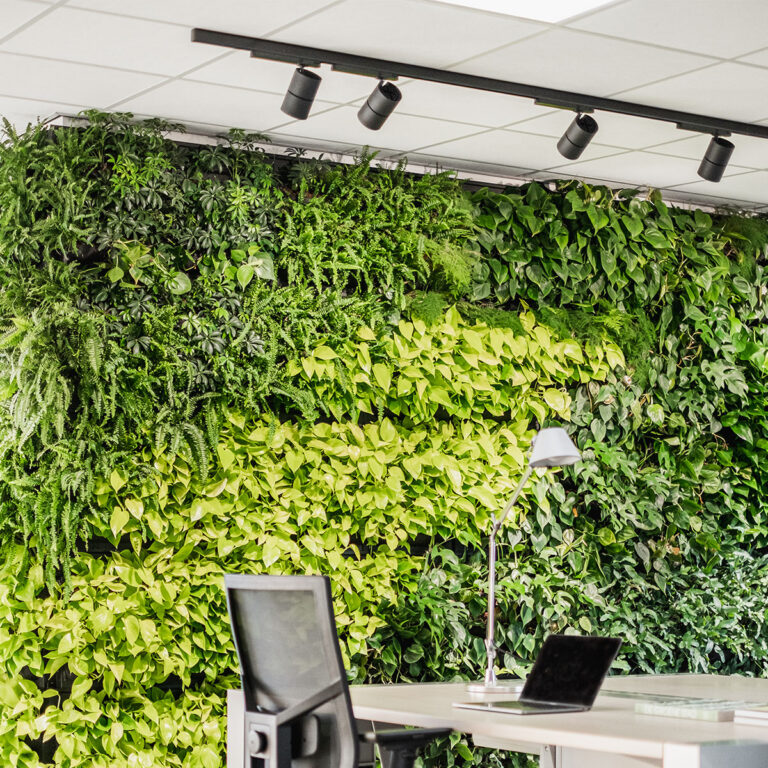
Scenario 1: The Interior Office Partition
A small business wants a 10×8 foot living wall but cannot afford the $8,000 professional quote.
-
Budget Strategy: Utilizing “off-the-shelf” plastic gutters or vinyl fence post caps mounted to a waterproofed plywood backing.
-
Constraint: Indoor drainage is non-existent.
-
Decision Point: Instead of a complex drainage system, the troughs are tilted slightly to a collection basin at the bottom, where a small $20 aquarium pump recirculates the water.
-
Outcome: The system is built for under $600, utilizing Pothos and Philodendron—plants that thrive in low light and irregular watering.
Scenario 2: The South-Facing Exterior Retaining Wall
A homeowner wants to cover an ugly 20-foot concrete wall.
-
Budget Strategy: Utilizing “Green Screen” wire mesh and climbing plants instead of a full hydroponic array.
-
Constraint: Intense heat and wind.
-
Decision Point: A true living wall would desiccate too quickly. By using a stainless steel mesh and planting “climbing” species like Star Jasmine in large troughs at the base, the “living wall” effect is achieved with 10% of the water and 5% of the maintenance of a vertical felt system.
Planning, Resource Dynamics, and Realistic Cost Ranges
A budget plan must account for both direct and indirect costs. A common mistake is forgetting the cost of “water treatment” or specialized fertilizers required for vertical substrates.
Estimated Costs (per 100 Square Feet)
| Item | DIY / Budget Optimized | Mid-Range Component | Proprietary Kit |
| Substrate/Hardware | $400 | $1,200 | $4,500 |
| Irrigation/Pumps | $150 | $500 | $2,000 |
| Plants (Plugs vs. Pots) | $300 | $900 | $2,500 |
| Waterproofing/Backing | $200 | $500 | Included |
| Total CAPEX | $1,050 | $3,100 | $9,000+ |
The “Resource Dynamics” here suggest that the greatest savings come from labor and brand-name markup. However, the “Maintenance Cost” of the budget system may be slightly higher in terms of time, as it may lack the sophisticated sensors of the $9,000 kit. The planner must weigh “Time vs. Money.”
Strategic Support Systems and Support Tools
Even on a budget, certain tools are non-negotiable for system survival.
-
Pressure Compensating Drip Line (PCD): Do not use standard soaker hoses. PCD lines ensure that the top of a 10-foot wall gets the same amount of water as the bottom.
-
Smart Battery Timers: A $40 Bluetooth-enabled hose timer allows for “pulsed irrigation”—watering for 2 minutes every 4 hours—which is essential for the low-volume substrates used in vertical walls.
-
Inline Water Filters: Small, $15 sediment filters prevent the tiny emitters in the wall from clogging with calcium or silt, a failure that can kill an entire zone in days.
-
PH/EC Handheld Meters: In budget hydroponic walls, nutrient drift is common. A simple $20 meter allows the owner to manually check the “food” levels in the reservoir once a week.
-
Liquid Seaweed/Kelp Extracts: These act as “stress reducers” for plants in vertical environments, helping them cope with the wind and heat of the vertical plane.
-
Aluminum Z-Girts: Used for the air-gap. They are rot-proof, lightweight, and provide a much more secure mounting point than wooden furring strips.
Risk Landscape: The Cost of Improper Planning
When considering how to plan living walls on a budget, one must identify “compounding risks.” A single failure in a horizontal garden is a brown spot; in a vertical garden, it is a chain reaction.
-
The “Wick” Effect: If the substrate or felt touches a porous surface (like gypsum board or untreated wood), it will “wick” moisture into the building structure, leading to structural rot that is invisible until it is catastrophic.
-
The Pump Vacuum: In recirculating systems, if the water level drops too low, the pump will run dry and burn out. A budget system must include a “low-water shutoff” or a large enough reservoir to account for three days of evaporation.
-
Pathogen Highway: Because water flows from top to bottom, a fungal infection in a single top-tier plant will be washed down to every other plant in the system. Budget systems must prioritize “clean” nursery stock and avoid using garden soil, which often carries pathogens.
Governance, Maintenance, and Long-Term Adaptation
A budget wall requires a “Stewardship Mindset.” Without the sensors of an expensive system, the human manager must become the sensor.
The Low-Cost Review Cycle
-
Weekly: Check the reservoir levels and test the “drain-down” time. If water is sitting at the bottom of the troughs for more than an hour, the drainage is clogged.
-
Monthly: Visually inspect the “emitters” (the points where water enters the wall). Use a small pin to clear any mineral buildup.
-
Quarterly: Conduct a “Leachate Test.” Pour clear water through the system and check the color and pH of what comes out the bottom. This tells you if salts are building up in the substrate.
-
Bi-Annually: Check all mounting hardware. The weight of a living wall increases as the plants grow and the substrate absorbs minerals; ensure the wall isn’t “sagging.”
Measurement, Tracking, and Evaluation
How do you know your budget plan is working? You must track the “Biology-to-Dollar” ratio.
-
Lagging Indicator: The “Replacement Rate.” If you are replacing more than 10% of your plants per year, your budget system is actually more expensive than a professional one over a 5-year period.
-
Leading Indicator: “New Growth Node Counts.” Every month, count the new leaves on 5 “marker plants.” This tells you if the nutrient and light levels are sufficient before the plant shows signs of stress.
-
Documentation Example: A “Photo-Log” taken from the exact same spot every 30 days. This provides an objective record of “coverage” and helps identify slow-moving pests like scale or mealybugs that are hard to spot in a dense vertical canopy.
Common Financial Misconceptions
-
“Succulents are the best budget plants.” While they use less water, succulents have very heavy, shallow root systems that often pull out of vertical substrates. They also grow slowly, meaning “coverage” takes years.
-
“Rainwater will irrigate the wall.” Most vertical walls are under eaves or are vertical enough that they “miss” most rainfall. You cannot rely on rain for a vertical system.
-
“I don’t need fertilizer if I use soil.” Soil in a vertical wall is quickly leached of nutrients by the frequent watering cycles. You must use a water-soluble fertilizer.
-
“Standard LED shop lights are enough.” Plants need specific PAR (Photosynthetically Active Radiation) levels. Using the wrong lights is a waste of electricity and leads to “leggy,” weak plants that fail.
-
“More water is better.” Over-watering is the #1 killer of budget walls. It causes root rot and attracts fungus gnats.
-
“I can just use a timer I found in the garage.” Living walls need multiple, short watering cycles. Most standard timers only allow for two cycles a day; you need a “cycle timer” or a smart timer.
Final Synthesis and Strategic Judgment
The pursuit of how to plan living walls on a budget is an exercise in “Strategic Essentialism.” It is about knowing where to be uncompromising and where to be creative. A living wall is a marriage of architecture and biology; if the architecture is sound (waterproofing and structure), the biology can be flexible.
The most successful budget walls are those that start small and expand as the owner learns the specific “personality” of their micro-climate. The “judgment” required is knowing when to stop adding plants and start improving the infrastructure. A budget wall is not a “cheap” version of a professional wall; it is a more “human” version—one that relies on observation and design intelligence rather than expensive sensors and proprietary hardware. When planned with forensic attention to moisture and air-gap dynamics, a budget living wall can outlast a high-end installation, providing a permanent, flourishing vertical ecosystem that proves biophilia is a right, not a luxury.